
Nov. 7 - Dec. 7 Online E-Conference
www.econf.org
|
|
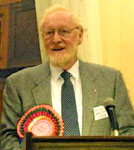
Keynote
Fools Rush In: A Mountain Dilemma
by Prof. Jack D. Ives, Carleton University, Ottawa, Canada.
Introduction
The
overview I have prepared possibly places too much emphasis on the topic:
glacial lake outburst flood (GLOF, in the current Himalayan argot;
jökulhlaup [Icelandic], my preferred term). I will introduce briefly
other topics, such as tourism and its impacts, and discrimination against
ethnic mountain minorities, even crimes against humanity, although I
assume that they will be amply enlarged upon during the process of this
e-conference. I also expect to provide several rejoinders.
Jökulhlaup (GLOF): definition:
It
is well to begin by defining what we mean by “GLOF”, the objective
of our discussion. The Icelandic term simply means: glacier (jökull);
leap (hlaup) – hence, glacier leap, the response of a glacier
to the usually sudden discharge of a large body of water, generally
from beneath the glacier front. The discharging flood is produced by
melting ice or snow or accumulating rain water, usually all three, that
has been ponded over time by the glacier in one, or more, of several
ways. The volume and frequency of the discharge is usually related to
the size (thickness) and relative imperviousness of the glacier. Water
will also often accumulate between the front of a thinning and retreating
glacier and its end moraines, formed when the glacier was more extensive,
usually implying that the climate was colder, or that solid precipitation
was greater than at present. In the Himalaya and Iceland, and many other
glacierized regions, these end moraines usually, but not invariably,
date from one of the maximum stands of the so-called Little Ice Age
(AD 1500 to 1900).
Lakes
impounded laterally to a glacier tongue, as in a tributary and unglacierized
valley (ice-dammed lakes sensu stricto) or bodies of water that
accumulated within or beneath the glacier, usually become smaller and
drain more frequently during periods of glacier thinning and retreat.
There are copious records of this from Iceland and many other regions.
In this case global warming reduces the magnitude, even the entire incidence,
of the jökulhlaup (an important Icelandic exception is Grimsvötn/Vatnajökull
– see Björnsson, 1988, 2002; Roberts, 2005).
The
term GLOF, as used within the present atmosphere of gross exaggeration,
applies particularly to moraine-dammed lakes. However, a lake that forms
by amalgamation of many small supra-glacial melt ponds may fall within
this category: Imja Lake, in the Khumbu, Nepal, and probably Tsho
Rolpa, Rolwaling, Nepal, which have been central to much on-going discussion,
are prime examples.
We
should bear in mind, therefore, that a warming trend will likely reduce
the hazard pertaining to ice-dammed lakes while increasing that resulting
from drainage of moraine-dammed lakes (there are other variations: e.g.,
ice-cored moraines damming lakes). Even so, many moraine-dammed lakes
burst out only once. The process of drainage breaches the moraine dam
thus reducing its capacity, entirely or partially, to allow additional
water to subsequently accumulate behind it.
My personal involvement
in jökulhlaup research
Iceland, 1952-54: student assistant in collecting data leading up to witnessing the 1954
Skeiðarárhlaup, Öræfi, Southeast Iceland.
Northern Labrador and Baffin Island: mapping field evidence for pre-historic glacial
lake
drainage.
Nepal Himalaya: Coordinator of the United Nations University’s (UNU) mountain
research
project, 1978-2000 (Co-directed with Bruno Messerli).
A
significant part of the UNU mountain project in Nepal involved assessment
and mapping of mountain hazards. The first area of detailed study was
Kakani, close in to Kathmandu. The second area was the Khumbu. In 1985
Kienholz and co-workers produced a multi-coloured map, scale 1:50,000,
depicting mountain hazards and it was concluded that the most serious
hazard was that deriving from the potential catastrophic outbreak of
glacial lakes (Zimmermann et al., 1986). Just as this phase of the research
project was coming to a close, Dig Tsho suddenly discharged and washed
away the small hydro installation that was nearing completion at Thame.
Several local people lost their lives and all the bridges for some 40
km downstream were washed out. Vuichard and Zimmermann, graduate students
on the original mapping project, returned to the Khumbu to undertake
an immediate post-facto examination of the Dig Tsho incident (Vuichard
and Zimmermann, 1987). At the same time, I noted many glacier lakes
in the wider area from examination of NASA satellite imagery. Drs Bradford
Washburn and Barry Bishop were also in the process of conducting a project
that produced high resolution conventional air photographs as a preliminary
for construction of the now famous National Geographic 1:50,000
scale contour map of the Mt Everest region. At the time the Nepalese
government had classified the photographs as “secret”. Dr Washburn,
however, managed to take home with him surreptitiously a full set. He
shared several of the photographs with me as they clearly identified
the 1985 extent of Imja Lake that I was able to compare with photographs
(in my care) taken in 1956 by my close friend of McGill University graduate
student days, the late Professor Fritz Müller. This demonstrated that
Imja Lake had begun to form well after 1956. The finding prompted the
re-focusing of a part of the UNU mountain project, specifically on Imja
Lake (Hammond, 1988; Watanabe et al., 1994). Watanabe has since followed
up this study to the present.
One
immediate result of all this was that Dr Colin Rosser, then Director
of ICIMOD, invited me to Kathmandu for the 1986 summer as Visiting Scholar
to undertake a thorough assessment of the Dig Tsho disaster. This resulted
in publication of ICIMOD Occasional Paper No. 5 (Ives, 1986). The report
concluded with a series of recommendations that, I believe, were the
first of their kind, however obvious, that related to the Nepal Himalaya:
basically, I urged that a detailed study and mapping should be undertaken
across the Nepal Himalaya so that hazardous zones could be identified
and steps taken to mitigate the danger faced by people living downstream
as well as infrastructure. I urged Dr Rosser to seize the opportunity,
on behalf of ICIMOD, to take a lead role in this highly relevant applied
research undertaking. Dr Rosser decided not to proceed. Similarly, while
I had received considerable assistance from Dr Vic Galay and staff of
the Water and Energy Commission, HM Government of Nepal, the government
also chose to ignore our recommendations – at least for more than
a decade. By the mid-1990s the situation had changed. Global warming
and associated GLOF hazards had become a politically “hot” topic.
ICIMOD, with UNEP, finally moved to take advantage of the rapidly changing
circumstances and produced the first inventory of glaciers and glacial
lakes for Nepal and Bhutan (Mool, et al. 2002, a, b – reviewed by
Reynolds and Taylor, MRD 24[3]: 272-274, 2004).
Arun III and the World Bank
The
growing concern about GLOF hazards became an essential element of the
World Bank and the Nepal Government’s determination to begin construction
on a mega-hydroelectricity project – Arun III. This is a major topic
in itself and goes well beyond my present purpose. However, some aspects
are introduced because I believe them central to the e-conference discourse.
Nevertheless, much detail and controversial dispute is readily available
in the standard literature (Gyawali, 2001; Gyawali and Dixit, 1997;
Ives 2006: 134-141, 236-237; Ives and Messerli, 1989: 111-113, 139).
The
potential threat of GLOFs arose as a possible impediment to an immediate
start on construction for Arun III. The World Bank assembled in Paris
in April 1995 a group of “experts” to discuss and advise upon the
hazard potential of a number of glacial lakes that had been identified
in the upper River Arun watershed above the proposed dam site. Experts
from the World Bank, the Government of Nepal, the main GLOF consulting
firm Reynolds Geo-Sciences Ltd. , and official observers from the governments
of Japan and Germany, two of the main possible donors, were invited.
In addition, two “outside and neutral” experts were invited to keep
the party honest.
It
may be of interest to participants of this e-conference to learn that
everyone present concluded that the GLOF hazard to the construction
site was minimal and could be easily averted after construction had
begun. This provided the World Bank justification for an immediate start
to construction. It should also be noted, however, that the discourse
was strictly limited to the GLOF hazard. Under no circumstances could
any other, especially negative, aspect of Arun III be introduced. On
the second evening of the “expert meeting” and during a private
dinner, Dr Hans Röthlisberger said to me that he thought the World
Bank was especially fortunate that its two “outside and neutral”
experts were honest as we both were opposed to Arun III on other grounds,
although we were denied the opportunity to broaden the discourse. Nevertheless,
just as I had been on the point of leaving my home, then in Davis, California,
to drive to Sacramento airport to catch a plane to Paris the morning’s
post arrived. It contained a manuscript for review sent me by Dr Teiji
Watanabe. This described his latest research on Imja Lake. I took it
to Paris with me to read on the plane. I felt that Teiji’s findings
were relevant to the Paris discussion and introduced them over strong
objections the final morning of the consultation – Imja Lake was not
located within the Arun watershed and therefore irrelevant. To which
I replied: but if a breakout of Imja Lake occurred causing loss of lives
and infrastructure that would probably have a significant impact on
the future of Arun III.
During
the subsequent coffee break the German government official asked me
for a copy of the manuscript. I explained that it was a privileged document,
but I would make a copy available dependent on Dr Watanabe’s concurrence.
He concurred. Subsequently I learned from a well-placed source (who
must remain anonymous for obvious reasons, even more than a decade later)
that the manuscript was a major reason for the German government withdrawing
as a donor for Arun III, which similarly influenced Japan. Perhaps the
main reasons for the collapse of Arun III, however, are those itemized
by Dr Dipak Gyawali, and which are readily accessible in the standard
literature (Gyawali, 2001; Gyawali and Dixit, 1997; Ives, 2006).
From
this point, we can turn to further research by Watanabe and his colleagues
on Imja Lake, and glacial lakes in Bhutan, and especially to Tsho Rolpa.
For the latter, however, I will defer to Dr John Reynolds who has vastly
more experience in the engineering deflection/mitigation of such hazards.
I will move instead to the relatively recent media discussion on GLOFs
in the context of Global Warming.
Meltdown in the Himalaya
The
term “meltdown” appears to have originated with Fred Pearce and
the New Scientist (Pearce, 2002: 44-48). He quotes John Reynolds
as warning that:
. . . . the 21st century could see hundreds of millions dead and tens of billions
of
dollars in damage [from GLOFs].
I hope John will qualify, or
comment on, this draconian statement in his subsequent contribution
to our e-conference. On the basis of known facts I believe that it would
be hard to defend such a statement. In my opinion, we have entered the
world of “overkill”, comparable to the warnings by the World Bank
and the Asian Development Bank (and many others) that no accessible
forest would remain in Nepal by the year 2000. It is now 2006 and there
is probably more accessible forest in Nepal than when these inflammatory
statements were published over a quarter century ago. But let us proceed.
The Guardian and The Times, amongst other leading newspapers,
have predicted that all the glaciers in the Himalaya will melt, these
reports often based on information obtained from respected scholars.
Furthermore, I have read that after the great meltdown and ensuing destructive
floods, the Ganges would be reduced to a trickle and hundreds of millions
would die from thirst (but surely, if global warming proves extensive
enough to melt all the glaciers, will it not still rain – as distinct
from snowing at high altitudes?).
Sets
of satellite images have been reproduced to demonstrate that Kilimanjaro
is losing its ice cap so rapidly that none will remain within a very
few years. Yet these so-called replicated pairs of photographs were
taken at different seasons: the first, post-monsoon, reflecting maximum
snow cover; the second, pre-monsoon, showing minimum snow
cover. Thus an illusion is presented to the inexperienced news media
reader/observor with the intent of high drama – and deceit? Another
example that is being increasingly used describes the crisis of total
disappearance of glaciers from Glacier National Park, Montana, USA.
It is stipulated that of nearly 40 glaciers within the park, more than
half have already gone. Again, the inexperienced reader is misled. These
numbers surely prove the extent of the disaster! Yet many of
these “glaciers”, even 30 years ago, were so small that some glaciologists
at that time argued that they were NOT glaciers but semi-permanent snow
patches (this is a deliberately controversial commentary and is not
intended to criticize the careful observations of Glacial National Park
personnel). Let me introduce here, however, a somewhat similar group
of ice-patches, permanent snow patches, and small glaciers with which
I became very familiar some 30 years ago. Nel Caine, of the Department
of Geography and INSTAAR, has kindly brought me up to date on the status
of ice and snow in the Colorado Front Range. In the case of the Arikaree
Glacier, the mass balance appears to have been close to zero from the
1960s until about 10 years ago. Since then it has been consistently
negative with an accumulated loss of about 10 m w/e (about 1 m/yr).
Half of this occurred in the two drought years of 2001 and 2002; 2002
is now rated as the “drought of record” for the State – i.e. the
driest in over 100 years. Most of the mass loss appears to have been
on the northern, more exposed part of the glacier. Caine reports an
average surface lowering of 17 m between 1968 and 2004. All of this
has had little effect on the area of the glacier – perhaps a reduction
of about 5% since 1963. The Arapaho Glacier has experienced somewhat
greater changes, but again related to solar exposure.
Nevertheless,
on the basis of my somewhat “old fashioned” education, I would characterize
some of the more dramatic statements introduced above, and they are
only examples amongst many, as unfounded (the kindest interpretation)
or downright dishonest. From the discussion so far, some of my readers
may be tempted to put me into the category of non-believers of global
warming (virtually akin to Holocaust deniers). I hope I can correct
this by explaining, using a single example; I have been systematically
photographing the glaciers of Öræfi, Southeast Iceland, for more than
50 years and have single-handedly accumulated a significant record of
glacier thinning and retreat (other researchers have conducted more
detailed glaciological studies in Öræfi than me). Nor am I remotely
challenging the widely assumed contention that global warming is occurring
and that it already has had a marked impact on the natural landscape.
I am merely protesting the clamour for gross exaggeration.
How do we
“save” Mt Everest from global warming?
In
the autumn of 2004 I received a request from Peter Roderick, an English
environmental lawyer, to join an appeal to UNESCO prepared by a group
of very distinguished environmentalists and mountaineers to “save
Mt Everest from global warming”. I asked if the appeal could be broadened
to include objectives that probably could be attained on a relatively
short-term basis. It proved inappropriate to modify the original text
to such an extent. Because I felt this left such an appeal too amorphous
for specific action I declined to sign it. A convivial discussion ensued,
much of which was formalized for publication in Mountain Research
and Development Volume 25(4): 394-398. Peter generously concluded
his reply to the effect that “we’re coming from the same place.”
This is correct. However, my suggestions had included the need for immediate
action on several urgent and practical matters stemming from Alton Byers’s
long-term research in the Khumbu and elsewhere (Byers, 2005): especially
action to curtail damage to the upper treeline-alpine meadow belt resulting
from severe impact by trekking tourists, mountaineers, and traditional
local practices. Fortunately, Alton and several colleagues, including
many local people, have attracted the funding attention of the American
Alpine Club, the US National Science Foundation, and the National Geographic
Society. This will begin the process of environmental and social action
to correct the damage, not only in the Khumbu, but in the Peruvian Andes
and other mountain regions. I raise this apparent contrast between short-term,
well-defined objectives based upon sound scientific research and big
picture altruism that appears to employ some of the excessively exaggerated
reporting to which I have referred above. This issue might be deemed
worthy of further discussion during our e-conference.
Social and Political
Problems
We
are all aware of the devastation that is being caused throughout many
of the world’s mountain regions by warfare in all its forms. I use
the term “warfare” in its broadest sense to include: full-scale
conventional war; defensive military stand-offs; guerrilla activities;
forced migrations and the growing number of both internal and external
refugees; expropriation of land for major infrastructure or for the
establishment of national parks; and pervasive discrimination against
the poor, the under-privileged, and the politically marginalized. To
blame mountain minorities for deforestation leading to severe downstream
damage (even though not proven and unlikely) as excuse for widespread
bans on tree-felling falls under my definition of “warfare”. In
this sense the THED (Theory of Himalayan Environmental Degradation)
some time ago promoted by major aid agencies and local governments can
be regarded as a form of warfare directed against the poor mountain
minorities.
This
issue of warfare, however, is such a large topic that it probably exceeds
the scope of this e-conference, although we may want to consider some
aspects. Let me introduce one example.
One
critical aspect, to my mind, is the plight of the more than 100,000
Lhotsampa (Bhutanese of Nepalese extraction) refugees currently in their
16th year of deprivation encamped in eastern Nepal. The case
is important for many reasons, the humanitarian one, of course, being
pre-eminent. Nevertheless, for our present discussion I want to highlight
several associated issues. In my estimation, we may be dealing with
a case of “crimes against humanity” perpetuated by the very government
(monarchical oligarchy) that publicly prides itself on its Buddhist
tenets of peace and humanity symbolized in the King’s claimed adherence
to “Gross National Happiness”.
In
effect, the plight of the Lhotsampas is exacerbated by the news media.
Not only is Bhutan perceived as the
ideal Himalayan kingdom (a latter-day Shangri-la), but its government’s
propaganda has effectively nourished this widespread “western” naivety
such that the refugees receive little popular support. For instance,
I have made repeated attempts to provide a number of newspapers with
a more balanced account as response to reports on the beauty and tranquillity
of Bhutan. All have been ignored. Moreover, the attempts that Seth and
I made to develop a discussion of the issue via the Mountain Forum e-network
were rebuffed as politically too sensitive. Are we not dealing
here with a form of “soft” censorship?
Recent
report from Kathmandu newspapers indicate that a “solution” is in
sight – the United States has agreed to resettle 60,000 of the refugees;
other industrialized countries have agreed to take in smaller numbers.
Yet this appears to have produced disputes in the camps. Several of
the camp leaders are reported to have objected to the “solution”
wishing to resist the offers and hold out for full repatriation. Many
of the long-suffering refugees appear to prefer immediate relief. If
the plan for extensive resettlement to third countries proceeds, does
this mean that Bhutan’s deliberate policy of forced migration of many
of its largest minority (the Lhotsampa are perhaps half of the total
population of Bhutan) is rewarded? Will this not appear as a case where
possible “crimes against humanity” are informally sanctioned as
politically expedient? Or is the implication raised here far too harsh?
Have we the fortitude to discuss this tragedy? Can we invite commentaries
from all sides of the issue, including from the refugee camps themselves?
For a thorough treatment of the Lhotsampa “problem” see Michael
Hutt, Unbecoming Citizens: Culture, Nationhood, and the Flight of
the Refugees from Bhutan (Oxford U Press, 2003).
In
this overview/introduction I have apparently emphasized two major topics
that may seem very far apart. I have moved from glacier meltdown to
entirely human meltdown. Perhaps there is a strong enough link. It is
worth considering that politics can have consequences that rival, or
far outweigh natural disasters. At least both sets of tragedies have
potential for impacts far beyond their points of origin. Finally, one
connecting factor is that both are permeated with misreporting by the
news media, if not deliberate misinformation.
Tourism and its Impacts
I
will do no more than introduce this important topic and leave it for
enlargement by the contributors to the e-conference. I am sure many
of us began with high hopes about how tourism, if properly managed,
could greatly benefit the people and landscape of the mountain tourism
destinations. I am equally sure that many of us have had severe disappointments.
Seth and I, and others, have been extensively involved in the Lijiang
area of northwestern Yunnan where our initial high hopes were dashed,
in part by inter-departmental rivalries within funding agencies, but
more especially by centralized governmental agencies determined to maximize
profits rather than work toward ensuring that the poorer local people
were able to benefit from real opportunities to achieve an “appropriate”
tourism. What is “appropriate” might well be taken up as a topic
for exploration.
Conclusion
In
reading through what I have written I find that I have presented a pessimistic
picture, despite maintaining that I am an inveterate optimist. Nevertheless,
there have been many positive developments over the last twenty years.
Perhaps we should try to catalogue these and discuss why some projects
have been successes while others have merely led me, at least, to feel
the need to quote the now somewhat ancient statement from The Times:
a definition of foreign aid – a process whereby the poor people of the rich
countries
give money to the rich people of the poor countries.
I
should also point out that many of the remarks I have made have been
deliberately construed to be provocative, so the proverbial “pinch
of salt” may be needed.
In
any event, Chapters 6, 7, 8, and 10 in Himalayan Perceptions
(2nd edition, Himalayan Association for the Advancement of
Science, Kathmandu, July 2006) might be worth reading, but especially
Chapter 10.
Jack D. Ives, Ottawa, Canada,
24th October, 2006.
e-mail: < jackives@pigeon.carleton.ca >
References
Björnsson, H. (1988): Hydrology of Ice Caps in Volcanic Regions, Societas Scientarium,
Islandica, Reykjavik.
Björnsson, H. (2002): Subglacial Lakes and Jökulhlaups in Iceland, Global and Planetary
Change, 35: 225-271.
Byers, A.C. (2005): Contemporary and Human Impacts on Alpine Landscapes in the
Sagarmatha (Mt Everest) National Park, Khumbu, Nepal, Annals
Association American Geographers, 95(1): 112-140.
Gyawali, D. (2001): Water in Nepal, Kathmandu: Himal Books.
Gyawali, D. and Dixit, A. (1997): How Distant is Nepali Science from Nepali Society?
Lessons from the 1997 Tsho Rolpa GLOF Panic, Water Nepal, 5(2): 5-43.
Hammond, J.E. (1988): Glacial Lakes in the Khumbu Region, Nepal. An assessment of
the hazards, unpublished Master’s thesis, Department of Geography,
University of Colorado, Boulder.
Hutt, M. (2003): Unbecoming Citizens: Culture, Nationahood, and the Flight of the
Refugees from Bhutan, Delhi: Oxford University Press.
Ives, J.D. (1986): Glacial Lake Outburst Floods and Risk Engineering in the Himalaya,
Occasional Paper No. 5, ICIMOD, Kathmandu.
Ives, J.D. (2006): Himalayan Perceptions: Environmental Change and the Well-being of
Mountain Peoples, 2nd Edition, Kathmandu: Himalayan Assoc. for the
Advancement of Science.
Ives, J.D. and Messerli, B. (1989): The Himalayan Dilemma: Reconciling Development
and Conservation, London and New York: Routledge.
Mool, P.K. et al. (2001a): Inventory of Glaciers, Glacial Lakes and Glacial Lake
Outburst Floods, Nepal, ICIMOD: Kathmandu.
Mool, P.K. et al. (2001b): Inventory of Glaciers, Glacial Lakes and Glacial Lake
Outburst Floods, Bhutan, ICIMOD: Kathmandu.
Pearce, F. (2002): Meltdown, New Scientist, 2 November, 176 (2367): 44-48.
Reynolds, J.M. and Taylor, P.J. (2004): Book Review, Mountain Research and
Development, 24(3): 272-274.
Vuichard, D. and Zimmermann, M. (1987): The catastrophic drainage of a moraine-
dammed lake, Khumbu Himal, Nepal: Cause and consequences, Mountain
Research and Development, 7(2): 91-110.
Watanabe, T., Ives, J.D. and Hammond, J.E. (1994): Rapid growth of a glacial lake in
Khumbu Himal, Nepal: Prospects for a catastrophic flood, Mountain
Research and Development, 14(4): 329-340.
Zimmermann, M., Bichsel, M. and Kienholz, H. (1986): Mountain hazards mapping in
the Khumbu Himal, Nepal, Mountain Research and Development, 6(1):29-40.
To participate in this e-conference, please join the Mountain Legacy Google group. When posting, please include your full name, nationality, and pertinent organizations with which you are affiliated. The MountainLegacy Google group is moderated: you will not receive spam through it, and your email address will remain confidential.

|
MountainLegacy |
| Browse Archives at groups.google.com |
