
Mountain Sisters
communities with a shared interest in mountains
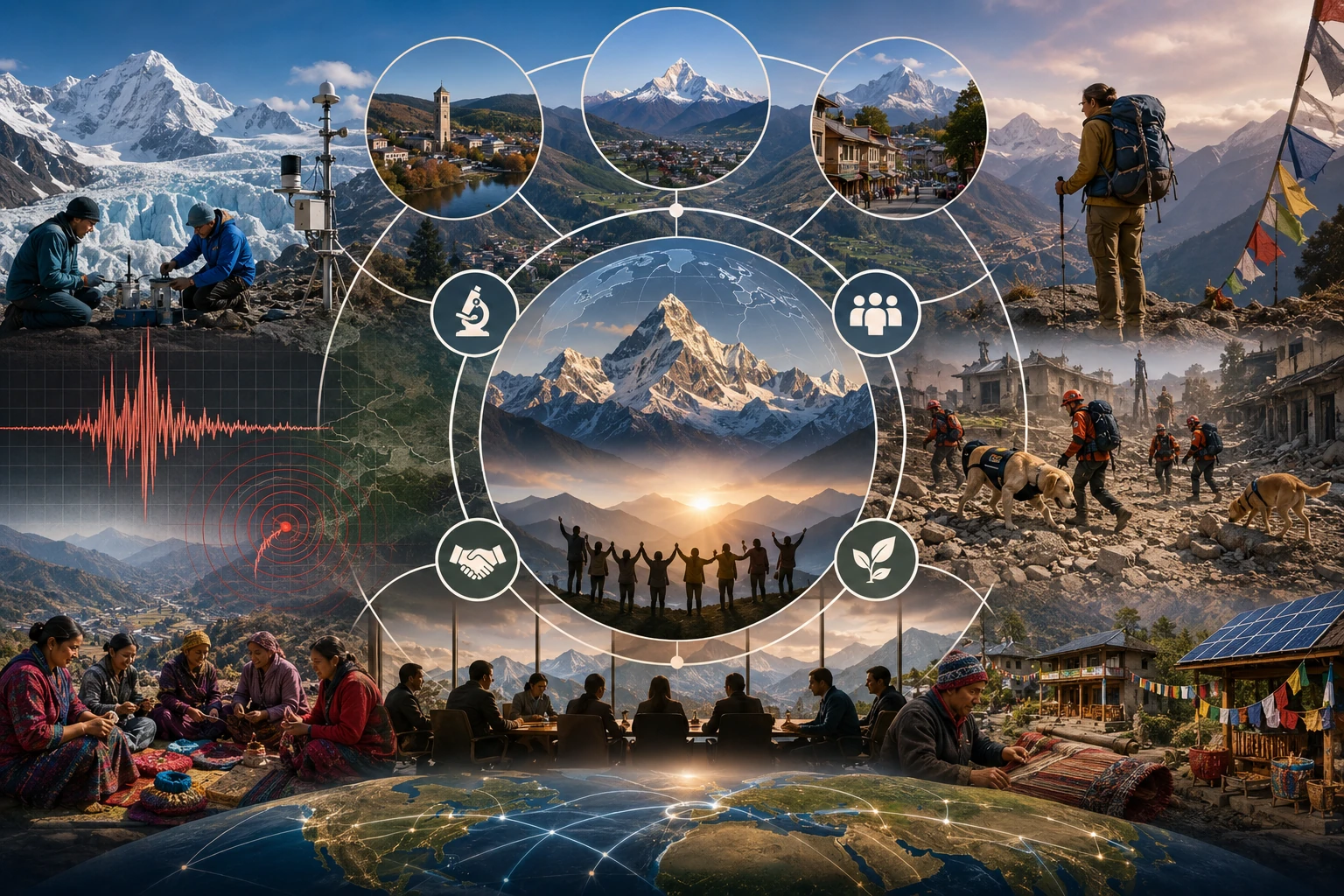
Mountain Sisters is our vision for a global network of communities united in grassroots collaborations to address the challenges and opportunities facing our mountainous regions and, through them, the entire world.
We are currently working on an established link between Ithaca NY and Pokhara (Nepal), as well as Three Sisters, a new initiative to connect Kathmandu, Istanbul, and New York City. Join us!
Moving Mountains to Center Stage
The world is shifting beneath our feet. For centuries, the great mountain systems were treated as marginal to human affairs: remote places, thinly populated and difficult to reach. That view is no longer tenable. Mountain regions are sources of water, biodiversity, cultural knowledge, and economic resources on which populations far beyond the highlands depend. They are also centers of geological and climatic risk, and are acutely sensitive to decisions made elsewhere.
The interdependence of highlands and lowlands is not a new discovery. It was recognized internationally in Agenda 21, adopted at the 1992 Rio Earth Summit. What remains difficult is turning recognition into effective collaboration.
Local action on global problems
Climate adaptation, disaster preparedness, watershed protection, zoonotic disease control, sustainable tourism, economic opportunity, biodiversity protection, and cultural resilience cross national boundaries. Yet many practical responses must be developed locally.
National governments and international institutions remain indispensable. But communities can often move in ways that large institutions cannot: they can exchange experience directly, bring together people with a personal stake in the outcome, test modest ideas without elaborate bureaucratic machinery, and sustain relationships across changes of political leadership.
Why Sister Cities?
Communities have formed privileged relationships with one another throughout history, for trade, mutual assistance, and cultural exchange. The modern Sister Cities movement gives such relationships a flexible civic framework.
Municipal recognition can provide legitimacy and continuity, but collaboration need not be confined to city governments. Universities, schools, businesses, professional associations, diaspora communities, service organizations, nonprofits, and individual citizens can all initiate projects and build relationships.
That flexibility is a strength. A Sister Cities relationship can support a university research partnership, a tourism initiative, an emergency-response exchange, a student program, a business collaboration—or a project that no central committee has yet imagined.
Mountain Sisters: an invitation to cooperation
Mountain communities share distinctive challenges and opportunities. Watershed protection, landscape stewardship, education, entrepreneurship, cultural preservation, infrastructure, tourism, and disaster management all take on particular dimensions at altitude. Communities facing such questions have much to learn from one another, and reason to make common cause on policies that affect them regionally or globally.
But Mountain Sisters is not intended as a network only of places located in the mountains. Lowland and metropolitan communities may have universities, research centers, diaspora populations, markets, transportation links, and other resources deeply connected to mountain regions.
Ithaca is one example. It is not a mountain city, but its educational and cultural institutions and its long-standing connections with Nepal, Tibet, and the Himalayas make it a natural partner in a mountain-focused network.
From relationships to projects
The possibilities are deliberately broad. Universities and researchers can share expertise and develop joint investigations. Communities can exchange experience in disaster preparedness and recovery. Tourism organizations can collaborate on destination management and professional training. Entrepreneurs can find partners, markets, skills, and investment. Diaspora communities can connect institutions in their places of residence with communities of origin.
Some projects may be philanthropic. Others may be educational, scientific, cultural, or strictly entrepreneurial. The common principle is simple: identify people with complementary interests and help them find one another.
What’s next—and how can you help?
Mountain Legacy led the initiative to link Pokhara and Ithaca and is now spearheading Three Sisters, an initiative connecting Kathmandu, Istanbul, and New York City. These are beginning points, not boundaries.
If you have an idea, a project, expertise to share, or simply an interest in exploring a possible collaboration, contact us. We will try to connect you with others who may be able to help—and every successful connection will help give shape and momentum to the larger Mountain Sisters network.
Contact
The Ithaca–Pokhara partnership and Three Sisters welcome individuals and organizations interested in developing specific collaborations in education, research, culture, tourism, business, environmental stewardship, and community exchange. If you have an idea or would like to participate, please contact Seth Sicroff, Co-Chair of the Ithaca-Pokhara Sister Cities Committee: sistercities@mountainlegacy.org.